Death in Korkyra (4/4 - My Month)
15–27 May 2026 – Centre for Culture Korčula
7 July – 20 September 2026 – Museum of Contemporary Art Zagreb
17 July – 17 August 2026 – Korčula Town Museum
17 July – 6 September – Wi-Fi Gallery grey) (area
On the occasion of the 20th anniversary of the death of the artist Željko Jerman (Zagreb, 10 March 1949 – Korčula, 17 July 2006), and 20 years of activity of the Grey Area, that launched its gallery program on 24 July 2006, an exhibition project is being realized that simultaneously marks two significant continuities – Jerman’s artistic legacy and two decades of work by a platform dedicated to contemporary art. The project is also part of a series of exhibitions organized by the Museum of Contemporary Art presenting works from the museum’s collection.
”My work belongs to those artistic tendencies in which the artist’s primary aspiration is to record his own existence in time and space, thereby affirming not only himself but humanity in general.” With these words, Željko Jerman introduced his diary work My Year in 1977, a work composed of black-and-white photographs and handwritten notes documenting the everyday events of a single year. This brief statement also encapsulates his artistic programme: art and life are not separate spheres but two aspects of the same reality. Photography is not merely a medium of recording but a means of affirming one’s existence in time.
My Year is one of the key works of Croatian conceptual art. Twenty years later, in 1997, Jerman realised My Year 2, executed in the same format but using colour photographs. He planned to complete a third instalment in 2007, but his premature death in 2006 interrupted that continuity.
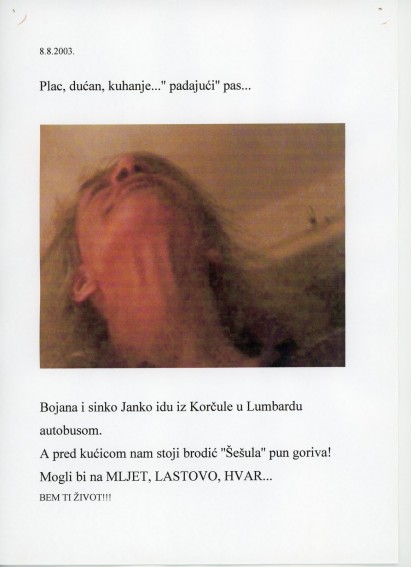
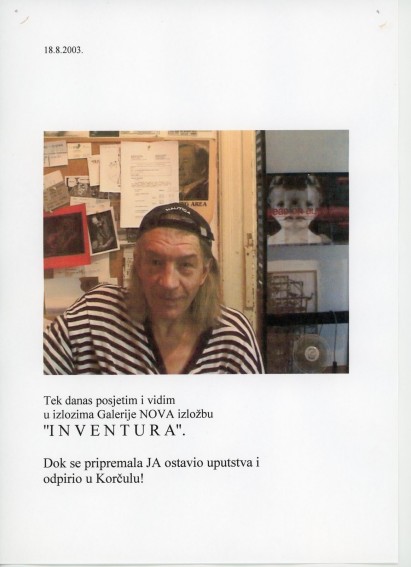
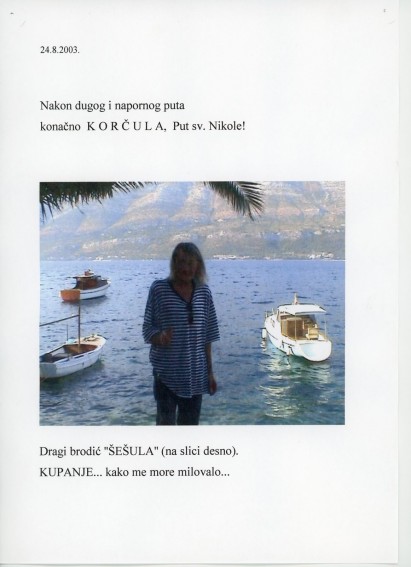
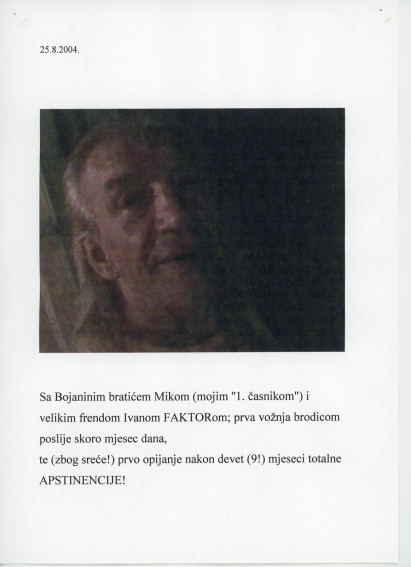
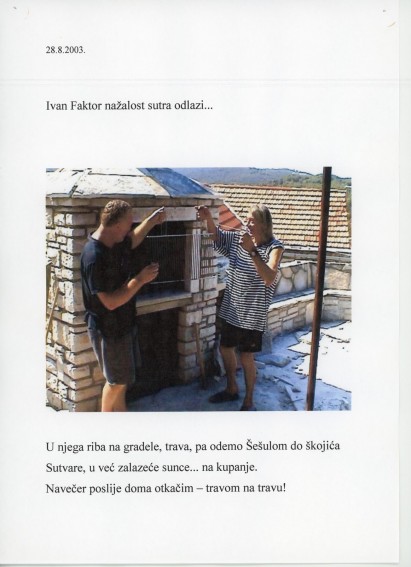
Within this sequence, My Month, created in August 2003, occupies a special place. Although it encompasses only a single month, it retains the same diary structure in which photographs and short textual entries intertwine to form a personal chronicle of everyday life. Unlike the earlier works, the entire piece was produced through direct computer printing on a home inkjet printer, so that image and text were created as a single printed surface rather than photographs being mounted afterwards. This technological shift reflects the period in which the work was produced, while leaving its underlying premise unchanged: everyday life remains the primary material of artistic practice.
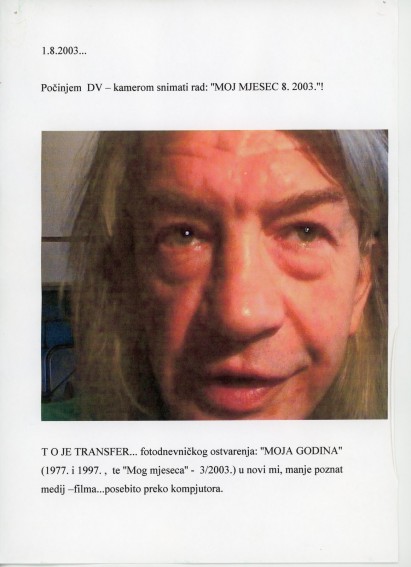
In its initial conception, Jerman also envisaged My Month as a video work. On the first of thirty-one computer printouts he wrote: “1 August 2003. I begin filming the work My Month 8/2003 with a DV camera.” Alongside a photographic self-portrait taken that day appears the text: “THIS IS THE TRANSFER of the photo-diary work My Year (1977 and 1997, and My Month 3/2003) into a new, less familiar medium—the film... especially through the computer.”
Interestingly, this note mentions a project entitled My Month 3/2003, for which no other documentation has so far been found. It remains unclear whether this refers to an earlier concept, a working title, or an unrealised project. In any case, Jerman soon abandoned the video diary and returned to the format that was closest to him—the combination of photography and text.
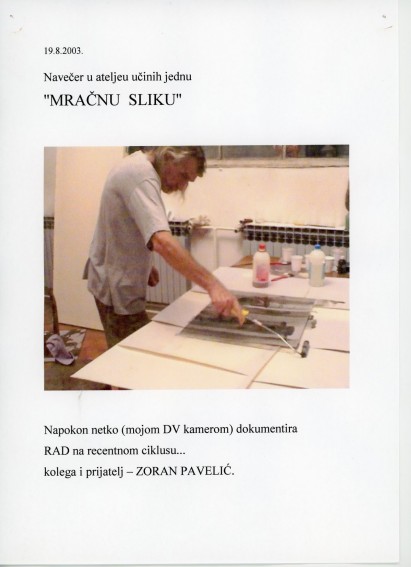
Jerman began August 2003 alone in Zagreb, frequently thinking about his family, who were already in Korčula. He travelled to the island later than usual that year and spent the month recording everyday events, encounters, journeys, and moods. The diary entries accord equal importance to ordinary moments of daily life and artistic activity. On the day before leaving for Korčula, he documents the making of a work from the Mrakača series, recording a period of abstinence from alcohol and the pleasure of ending that abstinence. As in My Year, the boundary between private life and artistic practice completely dissolves: everyday life is not the subject of art but its immediate substance.
With this exhibition, My Month is presented to Croatian audiences for the first time, in digital form. Until now it has been exhibited only once, in 2009 in Belgrade, as part of the group exhibition Reconstructions: Private = Public = Private = Public, curated by Darko Fritz.
The video footage recorded during August 2003 was entrusted by Jerman to his colleague and friend Ivan Faktor. Using this material, Faktor created the authorial documentary Željko Jerman – My Month, which was screened as part of the Grey Area programme in 2006. Although the premiere had been planned during Jerman’s lifetime, following his unexpected death the film inevitably acquired an additional commemorative dimension. Together with the diary work My Month, it constitutes the artist’s final major testimony to his persistent effort to transform his own existence into the space of artistic experience.
The exhibition can be accessed through personal mobile devices at Korčula’s St. Mark's Square. This digital art presentation format is organized by the grey) (area and realized in cooperation with the Korčula Town Museum and Format C. The Wi-Fi Gallery grey) (area has been set up on Pivilion, a free and open operating system developed by Dina and Vedran Gligo of Format C. The wireless local area network (WLAN) is publicly accessible and automatically displays digital artwork to anyone connecting to the Wi-Fi network, without a password or further action.
The exhibition series takes place across four venues in Korčula and Zagreb, bringing together works from the MSU collection, the Bojana Švertasek Collection, as well as extensive archival materials and photo documentation. The curatorial concept is grounded in the work Death in Corkyra, whose title symbolically evokes Jerman’s creative and existential context connected to the island of Korčula. It was precisely there that the artist realized a number of key projects and exhibitions – from the mosaic in Potirna (1981), now on permanent display in Vela Luka, to the solo exhibitions Korčula, My Working Town (ACI Marina Korčula and Centre for Culture Vela Luka, 1995) and In the Tavern Time Works (Centre for Culture Vela Luka, 2003).
An important place within this sequence is held by the exhibition Korkyra on My Mind, presented in 1994 at Gallery PM, HDLU, Zagreb, which further consolidated the relationship between the island setting and the artist’s conceptual reflection on the media of photography, text, and personal narration.
This multi-venue project affirms Jerman’s role as one of the key figures of the Croatian conceptual art scene, highlighting the specific interconnection between artistic practice, place, and memory, while confirming the continuity of institutional and independent collaboration in the presentation and reinterpretation of museum collections.
About author
Željko Jerman (Zagreb, 10 March 1949 – Korčula, 17 July 2006) was a Croatian contemporary artist and essayist, and one of the key protagonists of conceptual art in Croatia during the 1970s. After discontinuing his formal education in 1967, he devoted himself to photography, completed a photography course, and passed the exams required to run an independent studio. In 1970, he opened the photographic atelier Blow Up in Zagreb, and from 1972 to 1974 he studied photography by correspondence (FPS – Famous Photography School).
From the early 1970s onward, he radically reexamined the medium of photography, focusing on its technical and chemical properties. Rejecting the conventions of aesthetically “successful” photography, he deliberately produced blurred and “bad,” materially emphasized works, intervening directly in photographic paper with developer, scratching, tearing, and burning. In 1974, he initiated the cycle of elementary photography, reduced to the direct application of photochemicals onto paper without the use of a camera (Krepaj fotografijo!, 1974). His works from this period are strongly marked by processuality and existential intensity.
From 1975, he was active within the Group of Six Authors, with whom he carried out actions and exhibitions in public spaces. In the work My Year (1977), he encapsulated his artistic and personal positions of that time. In the late 1970s and throughout the 1980s, he developed multimedia approaches, incorporated text into his works, and intensively produced cycles of photo-paintings, which remained a constant in his oeuvre until the end of his life.
He was also active as a writer and critic, publishing in Polet, Studentski list, Danas, Studio, Oko, Jutarnji list, and Zarez. In 2006, his book Lost Portraits (Zagubljeni portreti) was published, and he continued writing his column Egotrip until the final days of his life.